

Author
Why Custom Chatbot Training Outperforms Generic Bots
Your generic chatbot confidently quotes the wrong return policy, can't check an order status, and quietly sends the customer to your inbox anyway. Every one of those moments costs you a sale or a support hour. Custom chatbot training is what closes that gap: it means building an AI chatbot on your business's own data, workflows, and customer interaction history, so it produces responses that generic, off-the-shelf bots simply cannot replicate. Where a generic bot draws from broad, pre-trained knowledge with no connection to your products, policies, or systems, a custom-trained bot uses techniques like retrieval-augmented generation (RAG), CRM integration, and confidence gating to deliver answers grounded in your actual business context. The performance gap between the two is not marginal. It shows up in accuracy, customer satisfaction, and operational efficiency in ways that directly affect revenue and support costs.
Why custom chatbot training outperforms generic bots on accuracy
Generic bots hallucinate. That is the core problem. Because they rely on static, pre-trained knowledge without access to your specific data, they generate plausible-sounding answers that are factually wrong for your business context. A customer asking about your return policy or current inventory gets a confident, generic response that may contradict your actual rules.
Custom-trained bots address this through production RAG systems that apply semantic chunking, hybrid retrieval combining BM25 keyword search with vector search, reranking, confidence gating, and citation grounding. These layers shift hallucination risk from the generation stage to the retrieval stage, where it is far easier to detect and correct. The practical result is that answers trace back to specific documents in your knowledge base, not to statistical patterns in a general-purpose model.
System design drives quality more than the base model choice. Two chatbots built on the same underlying large language model can perform very differently depending on how their chunking, retrieval, and citation enforcement are configured. This is why choosing a custom architecture matters more than picking the most popular AI model.
- Semantic chunking splits documents at meaning boundaries, not arbitrary character counts, preserving context for retrieval
- Hybrid retrieval combines keyword and vector search to catch both exact matches and conceptually related content
- Reranking scores retrieved chunks by relevance before passing them to the generation model
- Confidence gating suppresses answers when retrieved evidence falls below a reliability threshold
- Citation grounding requires every answer to reference a source document, making responses auditable
Pro Tip: Data preparation is the most underestimated step in custom chatbot training. Consolidating PDFs, emails, and internal docs into clean, well-structured chunks typically takes 5 to 15 hours before accurate training can begin. Invest that time upfront or your retrieval quality will suffer regardless of how good your model is.
How custom bots integrate with your business workflows
Generic chatbots function as standalone assistants. They answer questions but cannot take actions, update records, or hand off to a human agent with full conversation context. That limitation makes them useful for basic FAQ deflection and little else.

Custom chatbots connect directly to your internal systems through function calling and orchestration layers. Custom bots use RAG plus function calling to execute actions in CRM platforms, appointment scheduling systems, order management tools, and escalation paths. A customer asking about a delayed shipment gets a real-time status update pulled from your order system, not a generic "please contact support" response.
This integration depth produces measurable outcomes. Custom chatbots reduce support ticket volume by over 40% when handling complex workflows like refunds and escalations, compared to standard FAQ bots. That reduction translates directly into lower support labor costs and faster resolution times. You can explore how this works in practice through automated support with integrations.
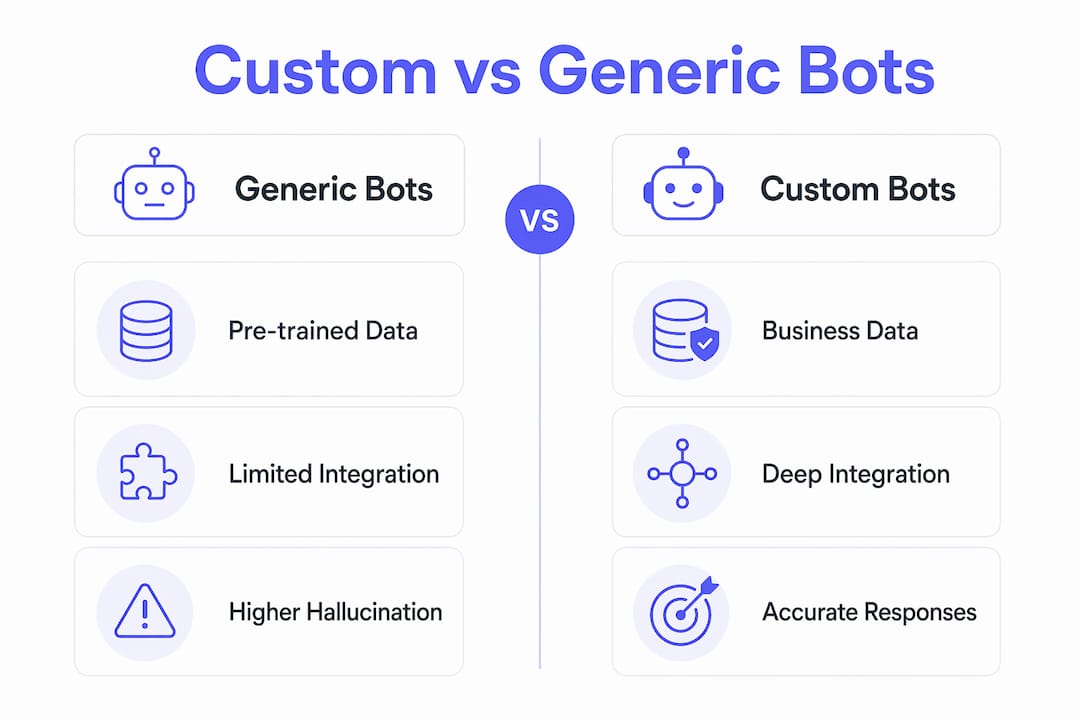
| Feature | Generic bot | Custom-trained bot |
|---|---|---|
| Knowledge source | Pre-trained general data | Your proprietary documents and databases |
| CRM integration | None | Reads and writes to your CRM |
| Order/appointment actions | Not supported | Executes via function calling |
| Escalation handling | Basic keyword triggers | Context-aware handoff with full history |
| Answer verifiability | No source citations | Citations linked to source documents |
| Compliance control | Limited | Configurable data residency and refusal rules |
When to choose custom training over off-the-shelf bots
The decision between custom and generic comes down to four factors: conversation volume, integration requirements, compliance obligations, and total cost of ownership over 12 to 24 months.
Custom training is preferred above roughly 5,000 to 8,000 monthly conversations and whenever proprietary system integration or compliance control is required. Below that volume threshold, a well-configured off-the-shelf tool may cover your needs at lower upfront cost. Above it, the per-conversation economics of a fixed infrastructure investment favor custom builds decisively.
| Decision factor | Favor generic | Favor custom |
|---|---|---|
| Monthly conversation volume | Under 5,000 | Over 5,000 to 8,000 |
| System integration needed | None | CRM, ERP, order management |
| Compliance or data residency | Standard | GDPR, HIPAA, or regional rules |
| Knowledge update frequency | Infrequent | Weekly or more often |
| Build timeline tolerance | Days | 4 to 12 weeks |
Compliance requirements deserve particular attention. Regulated industries in healthcare, finance, and legal services need chatbots that refuse out-of-scope queries, log interactions for audit, and keep data within defined geographic boundaries. Generic bots offer none of those controls by default.
Pro Tip: If you are not yet ready for a full custom build, a hybrid chatbot approach blends an off-the-shelf layer for routine queries with a custom AI layer for complex, proprietary workflows. This lets you scale capability incrementally without a full rebuild.
Key training strategies: RAG, fine-tuning, and response policies
The two primary technical approaches to custom chatbot training are fine-tuning and RAG, and they solve different problems. Understanding the distinction helps you avoid a common and expensive mistake.
Fine-tuning encodes your company's knowledge directly into model weights. It works well for capturing tone, writing style, and domain-specific vocabulary. The critical limitation is that fine-tuning cannot provide real-time updates. Once trained, the model's factual knowledge is frozen until you retrain it. For customer support, where pricing, policies, and inventory change constantly, that lag creates accuracy problems.
RAG retrieves fresh data at query time from your indexed knowledge base. It does not require retraining when your content changes. Update a product page or policy document, and the bot reflects that change on the next query. Decision-makers often assume fine-tuning is necessary to outperform generic bots, but RAG-based grounding delivers stronger operational value for frequently changing data.
The strongest architectures combine both. Fine-tuning handles voice and style consistency. RAG handles factual accuracy. Response policies then govern what happens at the edges:
- Refusal behavior routes out-of-scope queries to a human agent rather than generating a guess
- Confidence thresholds suppress answers when retrieved evidence is weak, preventing confident fabrications
- Citation requirements force every factual answer to reference a source, making the bot auditable
- Clarification requests prompt users to rephrase ambiguous queries before the bot attempts an answer
A hallucination-proof design mindset accepts refusal or caveats when evidence is insufficient, rather than risking a confident inaccuracy. For business use, that tradeoff is always correct.
Key takeaways
Custom chatbot training outperforms generic bots because tailored RAG architectures, deep system integrations, and response policies produce accuracy and operational control that pre-trained, isolated bots cannot match.
| Point | Details |
|---|---|
| RAG beats generic retrieval | Semantic chunking, hybrid search, and confidence gating ground answers in your actual business data. |
| Integration depth drives ROI | Custom bots connected to CRM and order systems reduce support ticket volume by over 40%. |
| Volume threshold matters | Custom training delivers better economics above roughly 5,000 to 8,000 monthly conversations. |
| Fine-tuning plus RAG wins | Use fine-tuning for tone and RAG for facts to keep responses accurate as your content changes. |
| Response policies prevent errors | Refusal routing and confidence thresholds stop the bot from fabricating answers at the edges of its knowledge. |
The architecture decision most businesses get wrong
From what I have seen working with businesses across e-commerce, professional services, and SaaS, the most common mistake is treating chatbot quality as a model selection problem. Teams spend weeks debating whether to use GPT-4o or Claude 3.5 Sonnet, then deploy with poor chunking, no confidence gating, and zero integration with their actual systems. The bot underperforms, and the model gets blamed.
The real lever is system architecture. A mid-tier model with well-engineered retrieval, citation enforcement, and proper escalation paths will outperform a frontier model dropped into a generic deployment every time. I have watched companies achieve dramatic support cost reductions not by upgrading their model but by fixing their chunking strategy and adding a confidence threshold.
The other misconception worth addressing: ROI timelines. Custom builds require 4 to 12 weeks and meaningful upfront investment. That timeline feels long when a generic SaaS tool can be live in an afternoon. But the comparison is wrong. You are not comparing setup times. You are comparing a bot that deflects 40% of your support volume accurately against one that frustrates customers with wrong answers and sends them to your inbox anyway. Plan your integration and escalation pathways before you write a single line of training configuration. That planning is where the ROI actually lives.
— Alyssa
Build a custom chatbot that actually knows your business
Generic bots answer questions. Chatwith builds chatbots that know your business. With Chatwith, you train a custom AI chatbot on your own website content, documents, and knowledge bases, then deploy it with 24/7 support across more than 95 languages and zero heavy coding required.
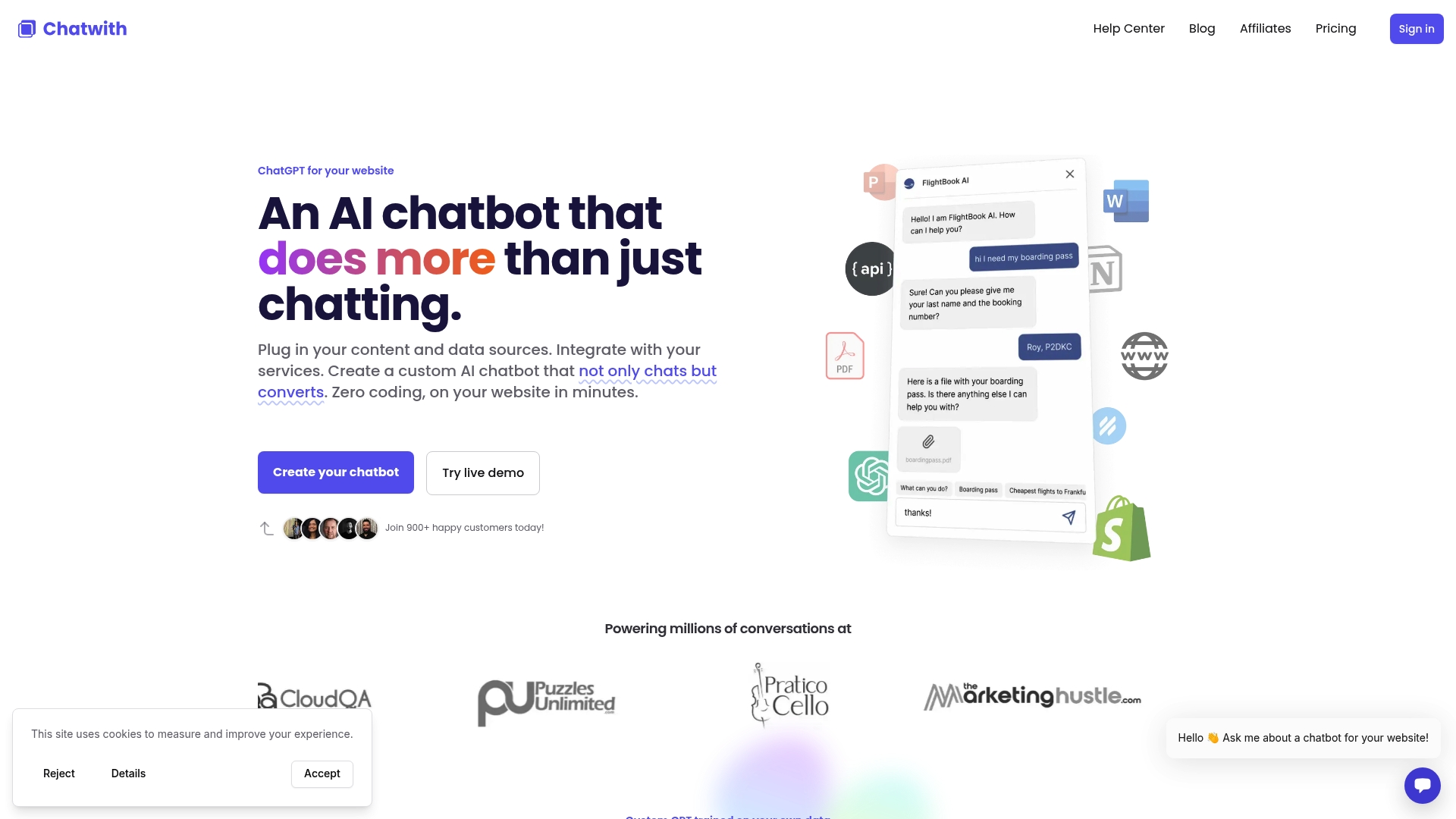
Chatwith connects to over 5,000 applications through API integrations, so your chatbot handles real workflows: lead capture, order status, appointment booking, and escalation to your team when needed. For businesses handling thousands of customer conversations monthly, that depth of integration is what separates a cost center from a competitive advantage.
Build a custom chatbot with Chatwith → — free trial, no credit card required, live on your website in minutes.
FAQ
What is custom chatbot training?
Custom chatbot training is the process of building an AI chatbot on a business's own data, documents, and workflows rather than relying on generic pre-trained knowledge. It typically uses retrieval-augmented generation to ground answers in proprietary content.
How does RAG reduce chatbot hallucinations?
RAG retrieves relevant content from your indexed knowledge base before generating an answer, so responses are grounded in your actual documents rather than statistical guesses. Confidence gating and citation requirements further reduce the risk of fabricated answers.
When does custom training make financial sense?
Custom training delivers better economics above roughly 5,000 to 8,000 monthly conversations, or whenever proprietary system integration or compliance control is required. Below that volume, a well-configured off-the-shelf tool may be sufficient.
Can a custom chatbot connect to my CRM or order system?
Yes. Custom chatbots use function calling and orchestration to read from and write to CRM platforms, order management systems, and appointment tools. Generic bots do not support this type of system execution by default.
Is fine-tuning or RAG better for customer support?
RAG is better for customer support because it retrieves current data at query time without requiring retraining when your content changes. Fine-tuning is best used alongside RAG to maintain consistent tone and style.
Recommended
More from our blog

Chatbot Versioning Explained for Developers in 2026
Discover what is chatbot versioning explained and how it ensures AI stability. Learn crucial versioning practices for reliable chatbot deployment!
Automate customer support using a chatbot with integrations
Automate your business. Go beyond Q&A by connecting your custom ChatGPT chatbot to 6000+ services for tasks like scheduling events, CRM updates, and more.