
Author
What Is an AI Chatbot Proof of Concept in 2026
Nobody wants to sink six figures into an AI chatbot only to watch it crumble the moment real customers start typing. A proof of concept is how you find out, in weeks instead of months, whether the idea actually holds.
An AI chatbot proof of concept (PoC) is a short-term, controlled experiment that tests whether a chatbot can solve a specific business problem using your real data before you commit to full-scale development. It sits at the very start of the AI chatbot development process. A typical PoC lasts 2 to 6 weeks and involves a small team of 2 to 4 people focused on one viability question, not a finished product. Modern LLM APIs and no-code chatbot platforms have made it faster and cheaper than ever to reach a meaningful answer in that window.
What is an AI chatbot proof of concept, exactly?
An AI chatbot PoC is a time-boxed experiment with a single purpose: determine whether a chatbot can meet a defined business goal using your actual data. It is not a demo, not a prototype, and not a pilot. The PoC answers one question before you spend serious money.
The distinction matters because most failed AI chatbot implementations trace back to skipping this step. Teams build on assumptions, use sanitized test data, and discover production problems only after months of development. A PoC surfaces those problems in weeks, at a fraction of the cost. Pre-built AI platforms and APIs allow teams without deep data science backgrounds to build functional PoCs for straightforward chatbot use cases, which means the barrier to running one is lower than most decision-makers expect.

The output of a well-run PoC is not a working chatbot. It is a documented, evidence-based recommendation to build, pivot, or kill the project. That distinction is what separates a PoC from a stakeholder demo.
How does a PoC differ from a pilot or full deployment?
The three phases of AI chatbot implementation serve completely different purposes, and confusing them is one of the most common and costly mistakes in the AI chatbot development process.
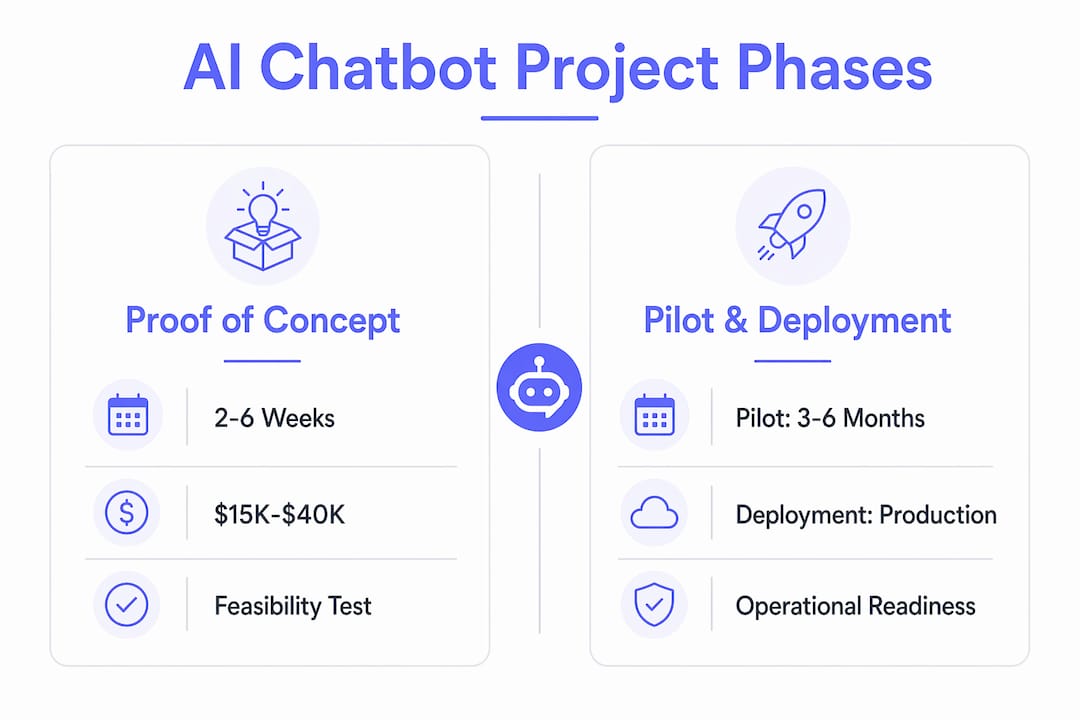
A PoC tests feasibility. A pilot tests operational readiness. A full deployment is production. Each phase builds on the last, and skipping ahead creates risk.
| Phase | Duration | Cost range | Primary question |
|---|---|---|---|
| Proof of concept | 2 to 6 weeks | 15,000 to 40,000 | Can this work at all? |
| Pilot | 8 to 12 weeks | 50,000 to 150,000 | Does this work at scale? |
| Full deployment | Ongoing | Varies significantly | How do we operate this? |
The cost difference between a PoC and a pilot is significant. A pilot costs three to ten times more and assumes feasibility is already established. Running a pilot before a PoC means betting 50,000 to 150,000 on an assumption you could have tested for 15,000 to 40,000. Sequential progression through these phases is not bureaucratic caution. It is how you avoid building on a foundation that was never validated.
Pro Tip: Define your go/no-go threshold before the PoC starts, not after. Teams that set pass/fail criteria in advance make cleaner decisions. Teams that set them after the results are in tend to rationalize continuation regardless of what the data shows.
What are the key components of an AI chatbot PoC?
A PoC without structure produces noise, not signal. The following elements separate a meaningful experiment from a well-intentioned waste of time.
- A single, precise business question. Not "can AI improve customer service?" but "can a chatbot resolve tier-1 billing questions with 80% accuracy using our current knowledge base?"
- Real, messy production data. Using only clean data in PoCs leads to production surprises. Edge cases and data gaps discovered during a PoC are a success, not a failure.
- Predefined pass/fail thresholds. A PoC without clear thresholds risks biased interpretation that favors project continuation over objective assessment.
- A small, cross-functional team. You need at least one technical person who can build and one business stakeholder who can evaluate results against real operational criteria.
- A fixed time box. Scope creep kills PoCs. If the experiment is not complete in six weeks, the question was too broad.
- Documented results. The output must be a written recommendation with supporting data, not a verbal summary in a meeting.
The most common pitfall is treating the PoC as a demo for executives rather than a learning experiment. A demo confirms what you already believe. A PoC answers what you genuinely do not know. That shift in mindset changes everything about how you design the test.
Pro Tip: Reviewing chatbot response quality during iteration is as important as measuring accuracy scores. Quantitative metrics miss tone, coherence, and edge-case failures that real users notice immediately.
How to create and test an AI chatbot PoC
The AI chatbot development process for a PoC follows a clear sequence. Deviating from it usually means repeating steps at higher cost.
- Scope the problem tightly. Start with a narrow use case that can produce a rough version quickly, even within a weekend. "Automate all sales" is too broad. "Auto-generate first-draft proposal summaries from CRM notes" is testable.
- Choose the simplest technology that could work. A RAG chatbot built on an existing LLM API or a no-code platform is the right starting point for most use cases. Build prompt engineering first, then upgrade only if results demand it.
- Load real data immediately. Do not wait until the chatbot "works" to introduce production data. The data is part of the test. Problems with your knowledge base are findings, not obstacles.
- Run structured tests with real users. Synthetic test cases miss the variation in how actual users phrase questions. Involve 5 to 10 real users from the target audience as early as possible.
- Measure against your baseline. If your current process resolves 60% of tier-1 queries without escalation, your chatbot needs to match or beat that number to justify the next phase.
- Manage conversation memory deliberately. LLM APIs are stateless, meaning your application must manage conversation history and context buffers. Failing to handle this produces inconsistent responses that tank accuracy scores in testing.
- Document and decide. Write up what worked, what failed, and what the data says. Then make the go/no-go call against your predefined threshold.
For teams exploring custom GPT configurations, integrating OpenAPI actions during the PoC phase can reveal integration complexity early, before it becomes a production problem.
What are the benefits and risks of running a chatbot PoC?
The primary benefit of a PoC is risk reduction. You spend 15,000 to 40,000 to avoid betting $500,000 on an unvalidated assumption. That math is straightforward, but the secondary benefits are equally important.
A well-run PoC generates the evidence executives need to approve budget. Tying PoC results to ROI metrics with dollar impact is the most effective way to secure buy-in from CFOs and decision-makers. Vague claims about "AI potential" do not move budgets. Documented proof that a chatbot resolved 74% of test queries without human escalation does.
The risks are real too:
- Misleading results from clean data. If your test set excludes difficult queries, your accuracy numbers will not survive contact with production traffic.
- Scope creep that turns a PoC into a mini-project. Once stakeholders see early results, the temptation to add features is strong. Resist it.
- Killing projects that needed one more iteration. A failed PoC is not always a dead end. Sometimes it reveals a data problem that is fixable, or a use case that needs reframing.
"The critical mistake in PoC design is treating it as a stakeholder demo rather than a learning experiment. PoCs should answer unknown questions, not confirm known facts." — Martin Tech Labs
Understanding how much time AI chatbots save on customer support gives you a realistic baseline for setting ROI expectations before your PoC begins.
Key takeaways
A successful AI chatbot PoC requires a narrow scope, real production data, predefined pass/fail thresholds, and a documented recommendation that drives a clear go/no-go decision.
| Point | Details |
|---|---|
| PoC scope and timeline | Run for 2 to 6 weeks with 2 to 4 people focused on one viability question. |
| Real data is non-negotiable | Test on messy production data, including edge cases, to get results that hold in production. |
| Set thresholds before you start | Predefined pass/fail criteria prevent biased interpretation after results are in. |
| PoC vs pilot distinction | A PoC costs 15,000 to 40,000; a pilot costs 50,000 to 150,000. Run them in sequence. |
| Output is a decision, not a product | The deliverable is a written recommendation to build, pivot, or kill. |
Why most PoCs fail to deliver real answers
I have reviewed enough AI chatbot projects to say this plainly: the majority of PoCs that "succeed" never actually answered the question they were supposed to test. They produced a polished demo, got applause in a boardroom, and then collapsed six months into development when production data behaved nothing like the test set.
The projects that generate real value treat the PoC as a structured experiment with a hypothesis. They write down what they expect to find, test against data that includes the worst-case queries, and document failures as carefully as successes. A PoC that kills a bad idea in four weeks is worth more than one that green-lights a flawed project with false confidence.
My strongest advice: involve a real end user in week one, not week four. Their first interaction with the chatbot will reveal assumptions your team did not know it was making. That feedback, collected early, is the most valuable output of the entire process.
— Alyssa
Start your AI chatbot PoC with Chatwith
Chatwith is built for exactly the kind of focused, data-driven testing a PoC requires. You can train a custom AI chatbot directly on your own knowledge base, documents, and data sources, then put it in front of real users within minutes, no significant code required. The platform supports over 95 languages and connects to more than 5,000 applications via API, so your PoC environment can mirror your actual production setup from day one. That matters: a PoC built on a throwaway prototype tells you little about how the real thing will behave, but a PoC built on Chatwith is already the foundation you launch on. When the experiment proves out, there is no rebuild, no gap between validation and production. Review the available pricing plans to find the right fit for your PoC budget and scale requirements.
Start your chatbot PoC with Chatwith → — free trial, no credit card required, live on your website in minutes.
FAQ
What is an AI chatbot proof of concept?
An AI chatbot proof of concept is a short, time-boxed experiment that tests whether a chatbot can solve a specific business problem using real data before full development begins. It typically runs 2 to 6 weeks and produces a go/no-go recommendation.
How long does a chatbot PoC take?
A standard AI chatbot PoC lasts 2 to 6 weeks and involves a team of 2 to 4 people. Anything longer usually means the scope was too broad from the start.
What data should I use in a chatbot PoC?
Use real production data, including difficult edge cases and messy inputs. Testing only on clean data produces results that do not survive contact with actual users.
How is a PoC different from a chatbot pilot?
A PoC tests feasibility and costs 15,000 to 40,000. A pilot tests operational readiness at scale and costs 50,000 to 150,000. Run the PoC first to confirm the idea is worth piloting.
What makes a chatbot PoC successful?
Success means meeting predefined pass/fail thresholds tied to real business metrics, not just getting the model to produce responses. A documented recommendation to build, pivot, or stop is the correct output.
Recommended
More from our blog
How to Train ChatGPT on Your Own Data: Complete Guide (2026)
Learn how to train ChatGPT on your own data — website content, PDFs, knowledge bases, and more. Build a custom AI chatbot without writing code, using 4 proven methods.
How to improve your custom ChatGPT chatbot responses
Why is it crucial to improve your chatbot responses? Learn how you can easily accomplish it by fine-tuning your ChatGPT chatbot using past conversations.