
Author
Types of Ecommerce Chatbot Interactions: 2026 Guide
Every day your store loses sales you never see: a shopper with a sizing question at midnight, a hesitant buyer who hits a dead end, a full cart abandoned because nobody answered fast enough. Ecommerce chatbot interactions are the distinct conversation patterns automated systems use to engage shoppers across the buying journey, from product discovery through post-purchase support. The most effective ones follow a hybrid architecture, blending rule-based precision with AI-driven flexibility for both control and conversational depth. It pays off: shoppers who engage with chatbot widgets convert at nearly 4x higher rates, and conversational AI-powered stores see a 23% overall conversion boost. That reflects a structural shift in how ecommerce businesses like those on BigCommerce and Shopify compete on customer experience.
What are the main types of ecommerce chatbot interactions?
Three core architectures define how chatbots communicate with shoppers. Each produces a different interaction style, and choosing the wrong one for your use case costs you both conversions and customer trust.
Rule-based chatbots operate on predefined if-then decision trees. Every response is scripted, which makes them predictable and easy to deploy for narrow tasks like FAQ handling or simple order status lookups. The tradeoff is rigidity. When a shopper asks something outside the script, the bot fails visibly.

AI-driven chatbots use natural language processing (NLP) and machine learning to understand shopper intent and generate contextually relevant responses. These bots handle open-ended questions, product comparisons, and nuanced support requests that rule-based systems cannot. The cost is higher setup complexity and occasional unpredictability in sensitive workflows like returns or checkout.
Hybrid chatbots combine rule-based control with AI flexibility, delivering predictability for critical tasks like checkout confirmation while staying open to complex, free-form queries. Hybrid architecture is widely regarded as the current best practice for ecommerce deployments. This model gives you guardrails where you need them and conversational range where shoppers expect it.
Pro Tip: Before selecting an architecture, map your top 10 customer service queries. If more than half are open-ended or context-dependent, rule-based alone will fail you within weeks.
What are the most common ecommerce chatbot use cases?
The ecommerce chatbot use cases below reflect how conversational AI enables specific interaction types across the full customer journey. Each use case demands a different communication style and bot configuration.
-
Product recommendation conversations. The bot asks qualifying questions about budget, size, or use case, then surfaces relevant SKUs. This interaction type works best with AI-driven bots that can interpret preference signals and cross-reference catalog data in real time.
-
Cart recovery interactions. When a shopper abandons a cart, the bot triggers personalized reminders and incentives via chat, email, or SMS. Personalization here is the difference between a recovered sale and an ignored notification.
-
Order tracking and status updates. A rule-based flow handles this well. The shopper inputs an order number, the bot queries the fulfillment system, and returns a status. No AI required, and adding it here introduces unnecessary risk.
-
Returns and refund processing. This interaction type benefits from a hybrid approach. The initial intake is rule-based (collect order ID, reason for return), but the resolution conversation benefits from AI flexibility when edge cases arise.
-
Lead capture and qualification. The bot collects contact details and purchase intent signals through a conversational form. This replaces static pop-ups with a dialog that feels less intrusive and converts at higher rates.
-
Customer support query routing. Effective bots classify shopper intent into categories such as product inquiry, returns, shipping, and billing, then route each conversation to the appropriate automated flow or human agent.
-
Post-purchase follow-ups. After delivery, the bot initiates a check-in, requests a review, or surfaces a reorder prompt. This interaction type drives repeat purchase rates and is chronically underused by mid-market ecommerce brands.
-
In-chat purchase completion. Conversational AI removes shopping friction by enabling in-chat purchases without redirecting the shopper to a separate checkout page. This is the highest-value interaction type for mobile-first stores.
How chatbot interaction types influence engagement and conversion
The data on chatbot-driven conversion is not marginal. Shoppers who engage with a chatbot widget convert at nearly four times the rate of those who do not. That gap exists because chatbot interactions reduce the friction between intent and purchase. When a shopper has a question at 11 PM and gets an instant, accurate answer, the sale happens. When they hit a dead end, they leave.
A successful chatbot strategy maps the entire customer journey: categorize the intents shoppers actually express, then route each one to a tailored automated flow for sales or support.
Intent classification is the mechanism behind this. Sophisticated systems classify up to 50 to 100 distinct shopper intents relevant to ecommerce, allowing each conversation to be routed to a precisely matched flow. A shopper asking about sizing gets a sizing guide. A shopper asking about a delayed order gets a tracking update and a proactive apology. Generic responses to both would damage trust equally.
Personalized chatbot interactions also reduce cart abandonment more effectively than broadcast email campaigns. The channel is synchronous, the message is contextual, and the shopper is still in a buying mindset. That combination is difficult to replicate with any other automated tool. For a deeper look at time savings from AI support, the efficiency gains extend well beyond conversion rates.
Which chatbot interaction type is best for each use case?
| Interaction type | Architecture fit | Ease of setup | Best for |
|---|---|---|---|
| Rule-based | Scripted decision trees | High | FAQ, order status, simple routing |
| AI-driven (NLP/ML) | Open-ended conversation | Medium | Product discovery, complex support |
| Hybrid | Rules + AI combined | Medium | Full-funnel ecommerce deployments |
| In-chat purchase | AI-driven with integrations | Low | Mobile-first, high-volume stores |
| Cart recovery | Hybrid or rule-based | High | Reducing abandonment at scale |
The hybrid model covers the widest range of ecommerce chatbot features without sacrificing control in high-stakes moments like checkout or refund processing. Rule-based bots remain the right choice for high-volume, low-complexity tasks where speed and consistency matter more than conversational range. For choosing the right chatbot for your specific stack, the decision usually comes down to how many open-ended intents your shoppers generate per session.
Key takeaways
Hybrid chatbot architecture delivers the best results in ecommerce because it combines rule-based reliability for critical workflows with AI flexibility for open-ended shopper conversations.
| Point | Details |
|---|---|
| Hybrid architecture wins | Combine rule-based control with AI flexibility for full-funnel ecommerce coverage. |
| Intent classification drives results | Classifying 50 to 100 shopper intents enables precise routing and higher conversion rates. |
| Conversion impact is measurable | Chatbot-engaged shoppers convert at nearly 4x the rate of non-engaged visitors. |
| Cart recovery needs personalization | Generic reminders underperform. Use contextual incentives via chat, email, or SMS. |
| Human handoff is non-negotiable | Define failure triggers before launch to protect brand reputation when automation reaches its limits. |
Why I stopped recommending pure AI chatbots to ecommerce clients
After reviewing dozens of ecommerce chatbot deployments, the pattern I keep seeing is this: brands that go all-in on AI-driven bots without guardrails create a different problem than the one they solved. The bot handles product questions beautifully, then completely mishandles a refund dispute and the customer screenshots it and posts it publicly.
Human handoff and failure triggers are not optional features. They are the difference between a chatbot that builds trust and one that erodes it. Every deployment needs a defined threshold at which the bot stops trying and routes to a human agent, with a message that acknowledges the limitation rather than pretending it does not exist.
My recommendation for most ecommerce businesses is a hybrid model trained on your own product catalog, policies, and past support conversations. That specificity is what separates a bot that actually helps from one that frustrates shoppers with generic answers. The best practices for website chatbots consistently point to training depth as the single biggest predictor of customer satisfaction scores.
— Alyssa
Build smarter ecommerce interactions with Chatwith
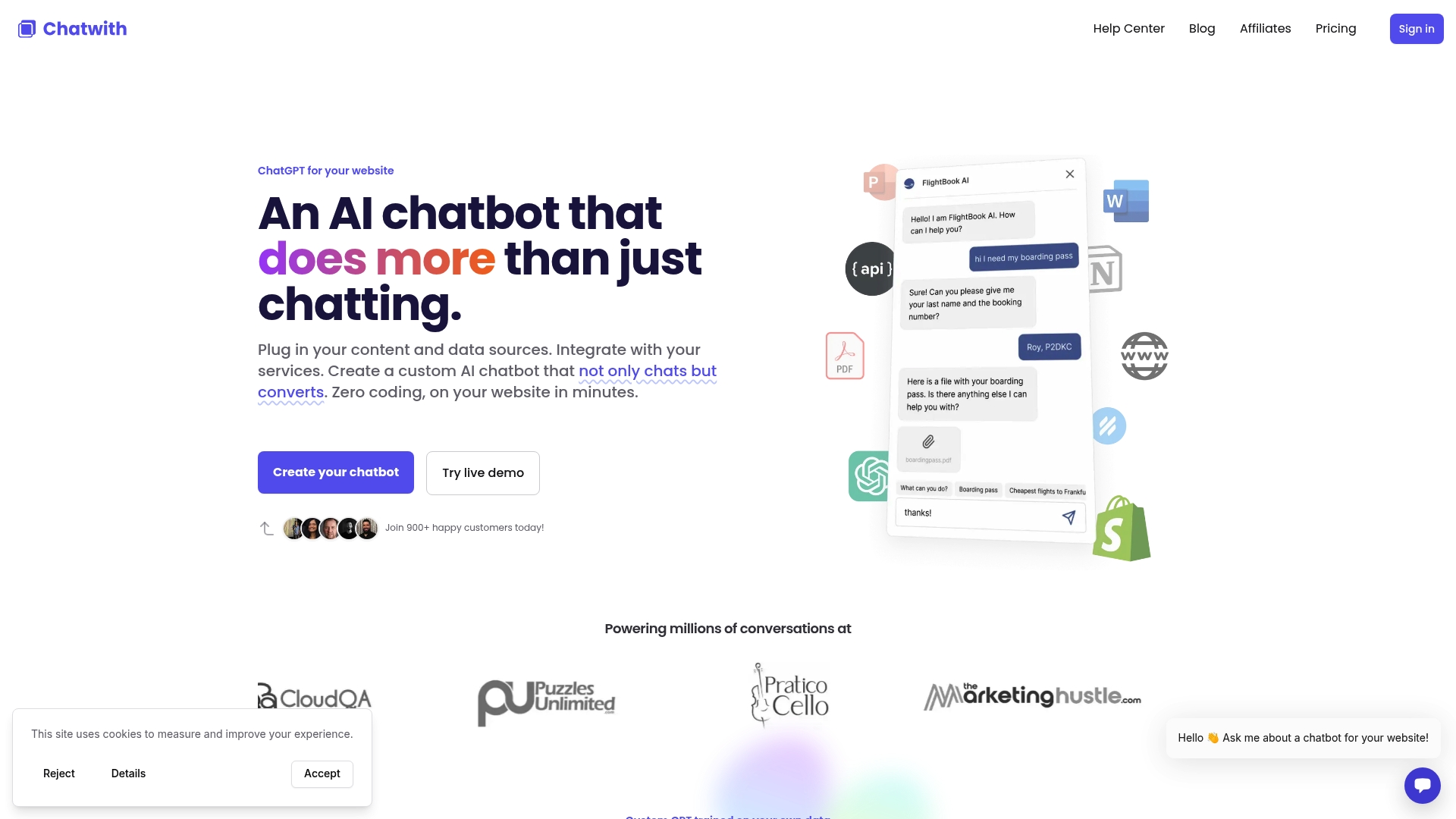
Chatwith lets you build custom AI chatbots trained directly on your product catalog, knowledge base, and support history. Unlike generic chatbot platforms that serve scripted responses, Chatwith's hybrid approach gives your store accurate, context-rich answers in over 95 languages, 24 hours a day. Setup requires minimal coding, and the platform connects to over 5,000 applications via API, so the bot can pull live order status, trigger cart recovery flows, and route handoffs into the tools you already run. Whether you need product recommendation conversations, automated order support, or post-purchase follow-ups, Chatwith covers the full ecommerce chatbot use cases list without forcing you to choose between control and flexibility. Review the Chatwith pricing plans to find the right fit for your store's interaction volume.
Build your ecommerce chatbot with Chatwith → — free trial, no credit card required, live on your store in minutes.
FAQ
What are the main types of ecommerce chatbot interactions?
The three core types are rule-based, AI-driven, and hybrid chatbot interactions. Hybrid models are the current best practice for ecommerce because they combine scripted reliability with conversational flexibility.
How do chatbots improve ecommerce conversion rates?
Shoppers who engage with chatbot widgets convert at nearly 4x higher rates than those who do not. Conversational AI-powered ecommerce sites see a 23% overall conversion boost by reducing friction between shopper intent and purchase.
What is the best chatbot type for cart recovery?
Hybrid or rule-based chatbots work best for cart recovery, using personalized reminders and incentives delivered via chat, email, or SMS to re-engage shoppers who abandoned without completing a purchase.
Why is human handoff important in ecommerce chatbots?
Defining failure triggers and escalation protocols prevents brand damage when automation reaches its limits. A bot that gracefully transfers to a human agent preserves customer trust far better than one that loops or gives irrelevant responses.
How many shopper intents should an ecommerce chatbot handle?
Effective ecommerce chatbot systems classify between 50 and 100 distinct shopper intents to personalize interaction flows intelligently across product inquiry, returns, shipping, billing, and post-purchase support.
Recommended
More from our blog
The essential chatbot terminology, glossary and definitions
Explaining the AI jargon: a guide to the commonly used chatbot terminology. This glossary will help you understand the world of chatbots.
How to write an FAQ for a website: Tips & Best Practices
Frequently Asked Questions (FAQ) pages are an essential component of many websites. In this blog post we present the tips and best practices for writing FAQs.