

Author
Top 4 Effortmark.co.uk Alternatives 2026
If you've outgrown Effortmark.co.uk and want a chatbot that trains on your own content—website pages, PDFs, knowledge bases, and videos—without pulling in a developer, you have better options in 2026. The hard part is finding one that ingests your existing material, answers accurately, and can actually take action, all without a steep setup. This comparison covers integrations, language support, source compatibility, and typical pricing so you can confidently pick a chatbot platform that fits your team's needs without expensive trial and error.
Table of contents
Chatwith
At a glance
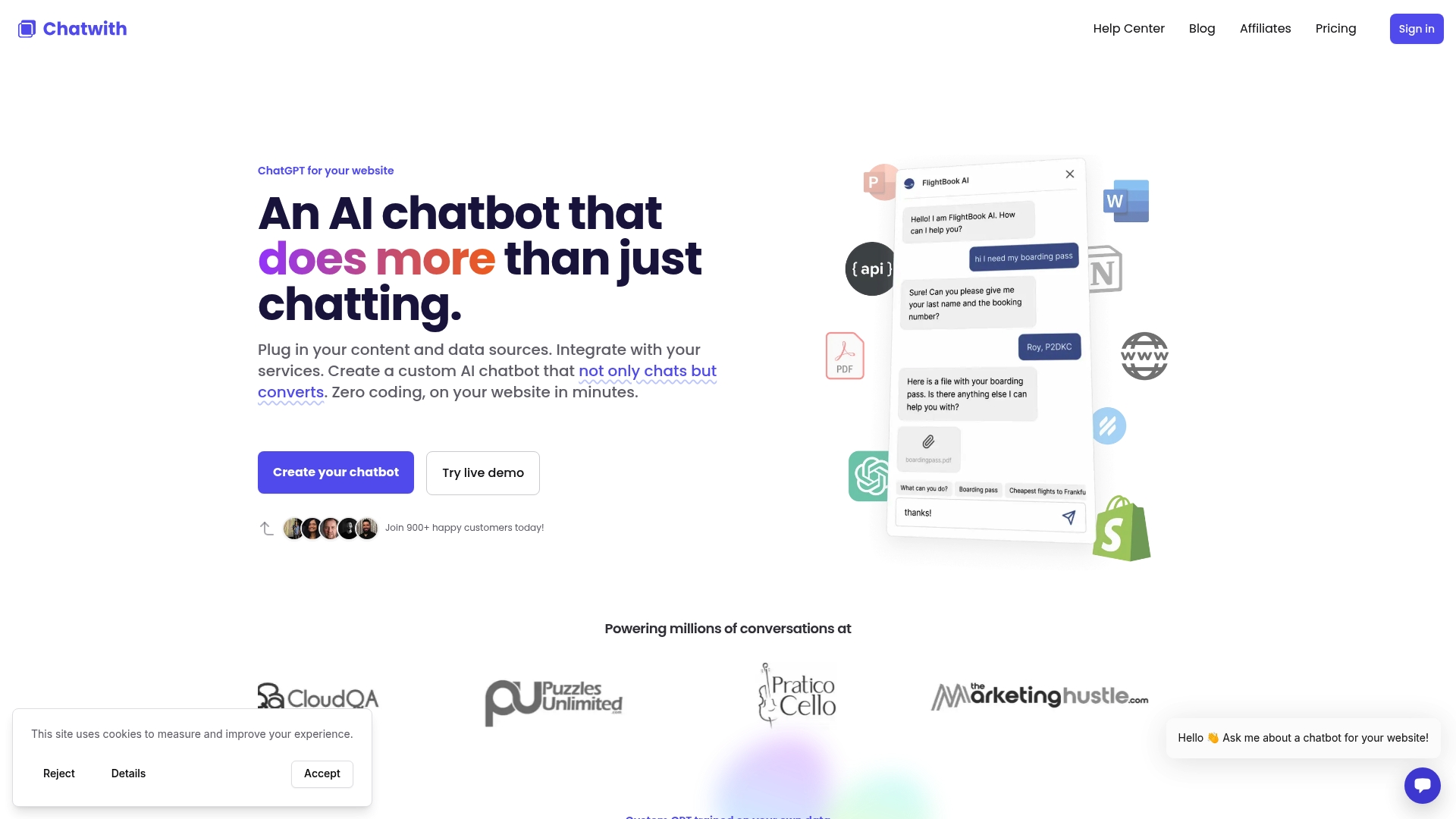
Chatwith lets teams train chatbots on website content, knowledge bases, PDFs, and YouTube videos. The platform supports chatbots that operate around the clock and can respond in over 95 languages. Setup requires little to no coding, which speeds deployment for customer support and e-commerce teams.
Core features
Chatwith ingests content from URLs, PDFs, knowledge bases, and videos so the bot answers with context from your sources. It offers integrations and APIs to call external services and automate tasks. The platform supports building multiple bots, white-labeling, team management, analytics, and connectors to common website builders and messaging apps. It also advertises the ability to connect to 5,000+ apps and APIs through custom actions called Custom GPT Actions.
Key differentiator
The clearest differentiator is the platform's focus on training bots from a wide mix of content types while keeping setup code-free. That lets teams convert existing documentation and media into an active support agent without rebuilding knowledge bases. The integration-first approach lets the chatbot trigger real actions such as inventory checks or appointment bookings.
Pros
-
Supports training on PDFs, web pages, knowledge bases, and YouTube videos, so your bot answers from the same documents your team uses daily. This reduces mismatched answers and speeds accuracy testing.
-
Multilingual responses for more than 95 languages let global support teams field questions without hiring extra agents. That lowers response time for non-English customers.
-
No coding required. Nontechnical staff can create and customize chat flows, which shortens the handoff between product owners and developers.
-
Integrations with common builders and messaging apps plus the vendor's API options enable live actions such as booking or order lookups. That moves the bot beyond canned replies into transactional support.
-
Community and customer support are reported as strong resources for setup and troubleshooting.
Cons
- Pricing can grow quickly with higher usage or when you deploy many separate chatbots. This makes cost planning necessary for fast-scaling stores.
Who it's for
Chatwith fits businesses that need easy-to-deploy, content-trained chatbots for websites and messaging apps. It matches e-commerce sites that want product support and order lookup automation. It also suits knowledge teams that want to reuse existing docs and media without rebuilding a separate dataset.
Unique value proposition
According to the company, Chatwith connects to over 5,000 apps and APIs, which lets the bot perform real tasks rather than only answer questions. That capability changes the chatbot from a passive FAQ to an active agent that can check inventory or schedule appointments. For teams that need bots to complete transactions, the integration footprint reduces custom engineering work.
Real world use case
An online store trains a Chatwith bot on its product pages, return policy PDF, and several tutorial videos. The bot handles sizing questions, suggests related products, and checks stock by calling the store's inventory API. Customer service sees fewer routine tickets, and the team focuses on complex issues.
Pricing
Plans start at $19/month for the Hobby tier and scale up through Standard and Business tiers. Pricing is usage based, so costs rise with higher traffic or multiple bots. Budget for increased spend if you expect heavy conversational volume or many integrations.
Website: https://chatwith.tools
AssistLoop
At a glance
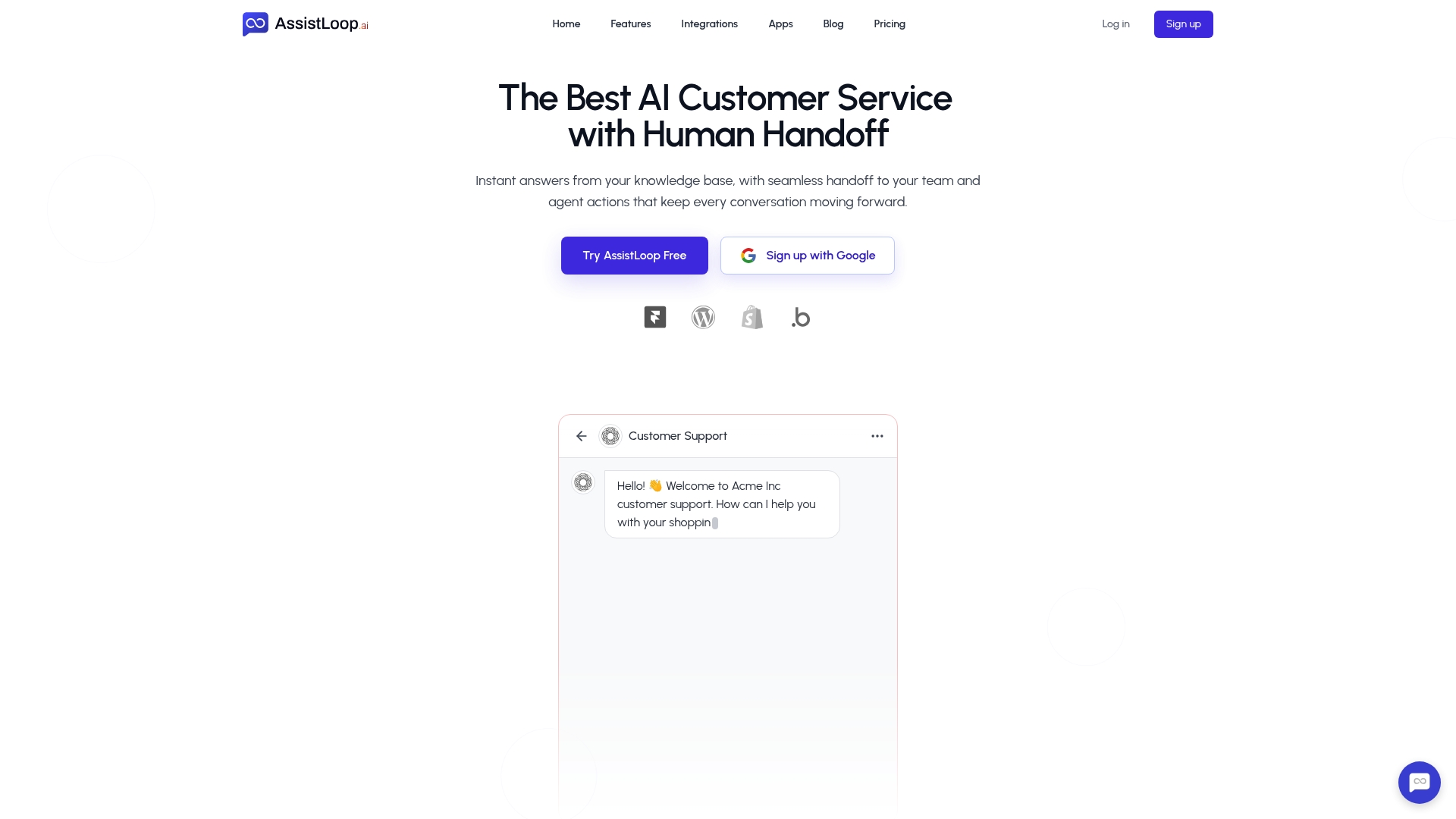
AssistLoop lets you pick which large language model powers each agent. That choice pairs with training on your own documents and knowledge bases to create agents that reflect your company voice. Reviews cite an easy interface and strong conversation flows, but also report recent bugs and occasional support gaps.
Core features
-
Customizable widget appearance: Match the chat widget colors and texts to your site for a cohesive customer experience.
-
Train on your own content: Connect internal documents and knowledge bases to teach agents product details and support policies.
-
Multi channel support coming soon: Plans list WhatsApp, Telegram, Instagram, and Messenger as future channels for wider reach.
-
Conversation logs and analytics: Store reviewable chat history and basic analytics to refine responses and spot recurring issues.
-
Choice of LLM models: Select from different large language models to balance cost, speed, and response style.
Key differentiator
AssistLoop focuses on high agent customization through direct training on your data and explicit LLM selection. That approach benefits teams that need tight control over tone and factual accuracy. Compared with Chatwith, which emphasizes broad integrations and deep site embedding, AssistLoop is narrower in scope and better suited for teams that prioritize control over a wide integration footprint.
Pros
-
Interface is intuitive and easy to navigate. Teams get up and running without a steep learning curve.
-
Advanced voice and conversation flows let you script multi turn exchanges rather than single replies. This reduces repeated clarifying questions.
-
High customization for agent behavior. You can tune responses to match brand voice and policy constraints.
-
Integrates into existing workflows with common web builders and scheduling tools. That lowers implementation friction for marketing and support teams.
-
Flexible pricing includes a free tier for small projects. That makes short trials and proofs of concept inexpensive.
Cons
-
Recent management changes have affected product quality for some customers. That has led to variable release quality.
-
Users report an increased frequency of bugs over time. Those issues can interrupt live chat and testing.
-
Unannounced updates sometimes change behavior and break flows. Teams with strict change control will need to monitor releases closely.
-
Support availability has gaps. Response times and SLA clarity vary by account.
When it may not fit
If your operation depends on mature multi channel coverage today, AssistLoop may be premature for your needs. The vendor lists expanded channel support as forthcoming, not currently available. Large enterprises that require strict release management and guaranteed uptime may find the update cadence risky. Teams that need guaranteed, responsive vendor support should evaluate service level expectations before committing.
Notable integrations
- WordPress
- Webflow
- Framer
- Wix
- Calendly
Who it's for
AssistLoop fits small to mid sized businesses that want tightly controlled AI agents. It suits support teams that maintain internal knowledge bases and want those documents reflected in chat responses. If you plan to tune model behavior and experiment with different LLMs, this product lets you test configurations without a big upfront cost.
Real world use case
A retail company connected product catalogs and support documents to AssistLoop to handle order status and returns questions. The agent answers routine queries around the clock and hands off complex cases to human agents. That setup reduced repetitive workload while keeping humans available for exceptions.
Pricing
AssistLoop offers a free tier and three paid plans. Pricing is listed as 25/month (Basic)**, **109/month (Pro), and $325/month (Business). The tier labels suggest a progression in features and capacity rather than per seat billing.
Botsonic
At a glance
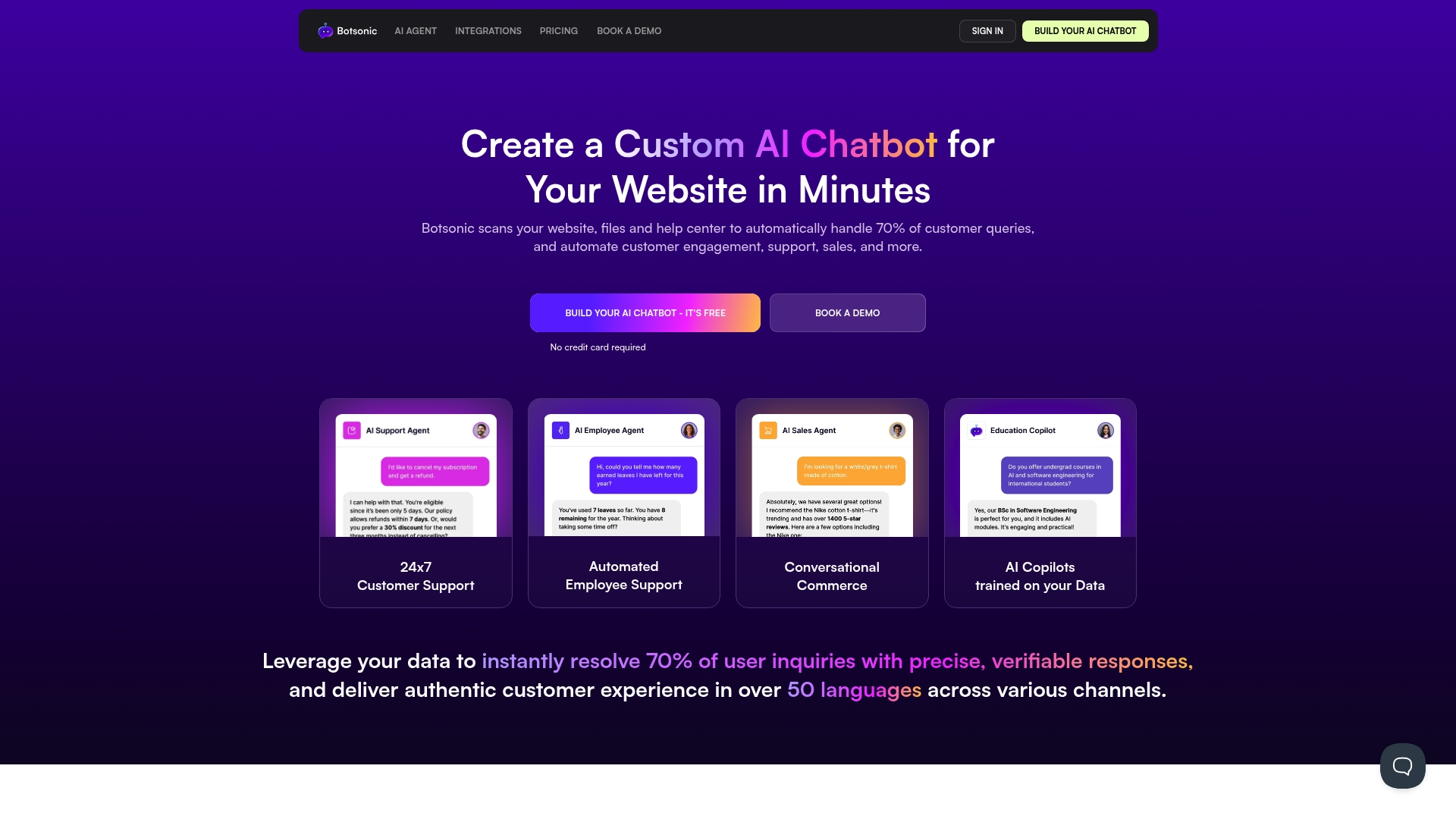
Botsonic's marketing materials state SOC 2, GDPR, and HIPAA compliance. This signals the vendor targets regulated industries that handle sensitive data. The platform supports more than 50 languages and offers omnichannel delivery across web, WhatsApp, SMS, Messenger, and Slack. Users can train agents from PDFs, Word files, spreadsheets, and cloud sources for rapid deployment.
Core features
- Create and deploy AI chatbots across web and messaging channels with minimal setup.
- Import documents and datasets for training, including PDFs, Word files, spreadsheets, and cloud storage.
- Customize chatbot appearance and conversational behavior to match brand voice.
- Omnichannel integration for web, WhatsApp, SMS, Facebook Messenger, and Slack.
- Monitor agent performance with real time analytics and dashboards.
Key differentiator
The vendor highlights a proprietary AI Model Gateway called GPT Router that routes requests between multiple models. That approach aims to keep responses fast and maintain quality under load. The router also makes it possible to mix model providers based on cost and latency. For organizations that need model-level control, this is a practical routing mechanism rather than a generic model chooser.
Pros
-
Intuitive setup and strong text generation. Users report the interface is easy to learn and agents produce high quality responses.
-
Flexible deployment options and fast customization. Teams can adapt agent behavior and UI without long engineering cycles.
-
Security and compliance focus. The company claims the platform meets SOC 2, GDPR, and HIPAA standards and includes encryption and audit logs.
-
Wide language and channel support. Supporting over 50 languages lets global teams serve customers on preferred platforms.
-
Advanced workflow capabilities. The product supports logic and reasoning flows that automate multi step tasks.
Cons
-
High cost at scale. Enterprise and advanced workflows increase spend quickly compared with lower tier competitors.
-
Low message caps on starter tiers. The free and lower cost plans limit monthly messages and can constrain growth for small teams.
-
Add ons required for some features. Live chat support, extra messages, or higher character volumes often need separate purchases.
When it may not fit
Small businesses with tight budgets will find the entry plans restrictive. Teams that expect large monthly message volumes may face high add on costs. Organizations that need unlimited messages on a low price point should consider simpler alternatives.
Notable integrations
- Zendesk
- Freshdesk
Who it's for
Botsonic fits medium and large organizations that need customizable AI agents across many channels and languages. Security conscious teams and regulated industries will value the compliance claims. Companies that plan to automate complex workflows and can budget for higher tiers will get the most value.
Real world use case
According to the company, one enterprise automated 70% of customer inquiries after deploying Botsonic. That reduction lowered support headcount needs and sped response times across web, WhatsApp, and email. The deployment used imported product manuals and CRM data to keep answers accurate and multilingual.
Pricing
Pricing follows a tiered model. The Starter plan lists 16/month** with annual billing or **19/month month to month. The Professional plan lists 40.83/month** annual or **49 month to month. Advanced lists 249/month** annual or **299 month to month. Enterprise pricing is custom and addons apply for messages, bots, and integrations.
Zoho CRM
At a glance
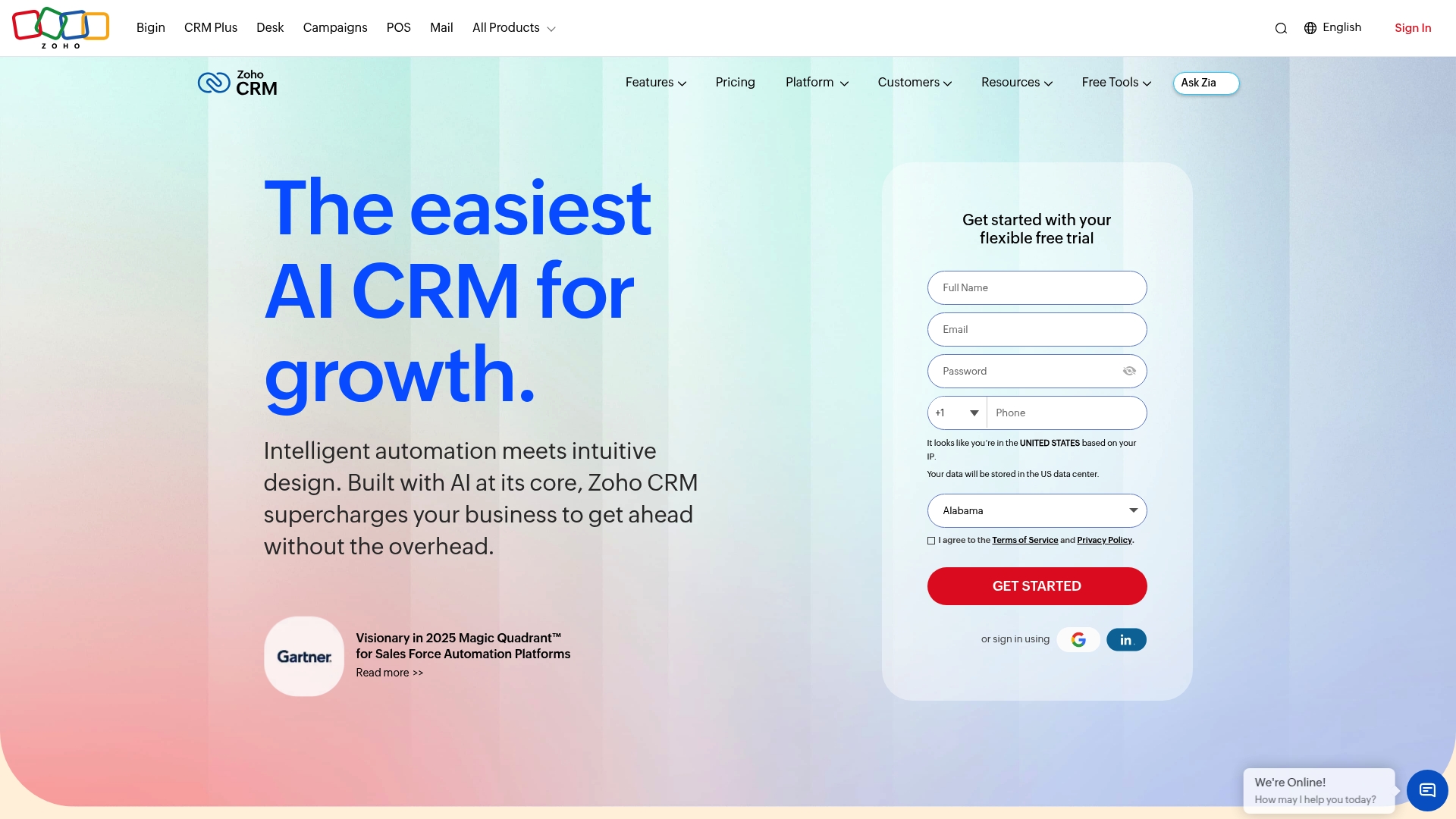
According to the company, Zoho CRM was named a visionary in Gartner's 2025 Magic Quadrant for sales force automation. That external recognition frames its position among enterprise sales tools. Zoho builds its product with AI at its core to automate routine work and surface sales insights.
Core features
Zoho groups capabilities around automation, customization, integration, analytics, and engagement.
- AI automation for sales processes that handles lead scoring, workflow triggers, and task suggestions.
- Customizable modules and interface so teams can model the CRM to their sales process and fields.
- Deep integrations with third party applications to connect email, marketing, and billing systems.
- Advanced analytics and reporting tools for pipeline visibility and sales performance tracking.
- Multi channel engagement across email, chat, and social to centralize customer conversations.
Key differentiator
Zoho emphasizes that AI sits at the center of its feature set. The product uses AI to automate repetitive sales tasks and to generate predictive insights for reps. That focus on AI and embedded automation separates Zoho from CRMs that only add AI as an optional layer.
Pros
- Strong value for budget conscious teams. The vendor advertises affordable tiers and a free plan, making trial and small deployments easier.
- Wide customization options let administrators tailor modules and page layouts to specific sales motions. This reduces the need for external development.
- Comprehensive lead and sales management tools cover scoring, assignment, and pipeline stages, which many sales teams rely on daily.
- Extensive third party connectivity supports common marketing, finance, and support tools, which helps avoid duplicate data entry.
- Recognition by Gartner is noted above. That placement supports Zoho's credibility among established sales automation vendors.
Cons
- A steep learning curve makes initial setup and adoption slow for teams without CRM experience.
- The interface can feel cluttered or dated, which raises training needs and reduces quick adoption by sales reps.
- Customer support can be slow or inconsistent, which creates friction when admins need fast troubleshooting.
- Some advanced features have bugs, so larger implementations should plan for extra QA and pilot phases.
When it may not fit
Zoho may not fit teams that need a minimal learning effort and an ultra simple interface. Companies that lack a dedicated CRM admin will find setup and customization time consuming. Organizations that require guaranteed rapid vendor support or a polished UI might prefer a product with a smaller feature set and faster support SLAs. If your rollout cannot tolerate intermittent feature instability, consider piloting first.
Who it's for
Zoho CRM suits businesses of many sizes that want flexible CRM customization without high license costs. It fits sales teams that plan to use automation and predictive insights to improve throughput. It also fits organizations that need broad third party connectivity and are willing to invest in admin time.
Real world use case
A mid sized retail company uses Zoho CRM to capture web leads automatically and assign them to local sales reps. The company configures workflows to schedule follow up tasks and to push qualified leads into targeted email campaigns. AI-driven insights help the marketing team focus offers on segments that show higher conversion.
Pricing
Zoho offers a free plan to start. Paid plans scale by feature set and company size, with higher tiers unlocking advanced automation and analytics. The vendor markets this structure as a lower cost option compared with many enterprise CRMs.
Comparison of alternatives
Choosing a chatbot solution involves assessing diverse capabilities, such as integration options, multilingual support, and scalability.
Integration and source diversity
Chatwith.tools excels at utilizing diverse data inputs like PDFs, websites, and videos for training AI chatbots, providing rich bot responses while inviting ease of customization. AssistLoop emphasizes individual channel adaptability and content control, making it practical for teams that favor tailored agent behavior over breadth of input sources.
Compliance and industry tailoring
For organizations in regulated industries requiring compliance and data security, Botsonic offers SOC 2, GDPR, and HIPAA adherence, combined with omnichannel messaging support across platforms like WhatsApp and Facebook Messenger. These features prioritize legal adherence while facilitating communication diversity, establishing Botsonic as a specialized fit for security-conscious domains.
Best fit
- For users aiming to integrate bots with content from sources like videos, PDFs, or websites, enabling real-time, multilingual responses, Chatwith.tools is a leading choice.
- Teams focused on data security or operating in highly regulated industries would benefit most from Botsonic due to its compliance-driven features.
- Companies looking for low-cost entry with high customization flexibility could consider AssistLoop, especially when testing various language models for performance evaluation.
Our pick
Chatwith.tools stands out for its ability to train chatbots on a wide array of content sources combined with multilingual output capabilities. These features make it a strong choice for enterprises seeking responsive chatbot experiences. However, organizations in highly regulated sectors might prefer solutions like Botsonic, which prioritize compliance.
Discovering a suitable chatbot platform involves evaluating offerings by their ability to integrate with diverse data sources, ease of deployment, and scope of customization.
| Product | Key Features | Best For | Pricing | Limitation |
|---|---|---|---|---|
| Chatwith | Integrates diverse content types; multilingual | Teams needing content-trained, multilingual bots | $19/month and up | Costs increase with traffic or bots used |
| AssistLoop | Customizable chat agents; direct LLM selection | Small businesses valuing high customization | $25/month and up | Limited multi-channel support at this time |
| Botsonic | SOC 2, HIPAA compliance; omnichannel integration | Enterprises in regulated industries, medium/large | $16/month and up | High scaling costs and restrictive starter tiers |
| Zoho CRM | AI-driven insights; sales task automation | Organizations with sales-focused CRM needs | Free plan available; paid tiers scale by features | Interface complexity and variable feature stability |
Discover how Chatwith stands out among Effortmark.co.uk alternatives
Choosing the right AI chatbot can feel overwhelming with so many options. If you want a solution that trains chatbots directly on your own website content, PDFs, and videos while supporting over 95 languages, Chatwith delivers exactly that. It removes guesswork by connecting your existing knowledge bases and automating real-time actions through its integration with over 5,000 APIs.
Key benefits include:
- Quick setup with minimal coding required
- Deep context-rich responses from your actual documents
- 24/7 multilingual customer support
Explore Chatwith now to get a custom bot running on your site that reduces repetitive tickets and empowers your team. Import your site data or PDFs today and see your chatbot answer questions with accurate, actionable information.
Try Chatwith free → — free trial, no credit card required, live on your website in minutes.
FAQ
How does Chatwith support multilingual responses?
Chatwith supports responses in over 95 languages, allowing global teams to provide customer support without needing additional agents. This multilingual capability ensures that non-English customers receive prompt assistance, enhancing the overall user experience. Teams should consider using Chatwith to effectively manage diverse customer inquiries across multiple languages.
What is the difference between Chatwith and AssistLoop?
AssistLoop excels in agent customization through direct training on your data and explicit large language model selection. In contrast, Chatwith is particularly beneficial for quickly training chatbots on various content types without coding, making it more suited for teams that need rapid deployment. Organizations that prioritize detailed control over agent behavior might prefer AssistLoop, while those seeking ease of use and setup should consider Chatwith.
Which chatbot builder allows for live integrations?
Chatwith offers integrations with common website builders and APIs, enabling transactions like booking appointments or checking inventory. This feature moves Chatwith beyond simple answering capabilities, making it an active support agent that can perform real-time actions. Businesses looking to automate specific workflows should utilize Chatwith for its robust integration options.
Can I use Chatwith if my business scales rapidly?
While Chatwith is designed for quick deployment with a code-free setup, pricing can escalate as usage increases or when multiple bots are deployed. Users should plan their budget accordingly as costs can rise significantly with high traffic or numerous integrations. Businesses should evaluate their scale and usage to manage expenses effectively.
How does Chatwith excel in training from existing content?
Chatwith ingests information from diverse sources, such as PDFs and knowledge bases, allowing the chatbot to provide accurate answers based on the same documents that teams use daily. This capability minimizes mismatched responses and speeds up the accuracy testing process, making it a strong choice for teams looking to leverage their existing documentation.
More from our blog

Chatwith is GDPR compliant. A guide for chatbot owners.
Discover how Chatwith ensures GDPR compliance to protect your and your customers' data privacy effectively.
How to improve your custom ChatGPT chatbot responses
Why is it crucial to improve your chatbot responses? Learn how you can easily accomplish it by fine-tuning your ChatGPT chatbot using past conversations.